
Your Business Insurance Fire Risk Check
Your Business Insurance Fire Risk Check
Your Business Insurance Fire Risk Check
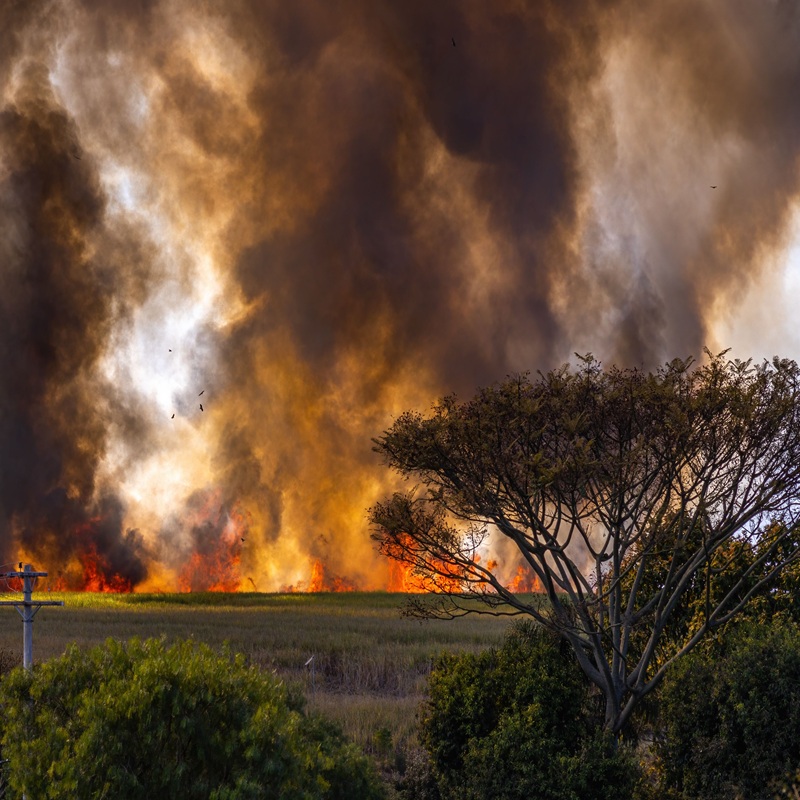
Last summer was the UK’s hottest on record and 2026 is on course to beat it. With extreme temperatures driving more outdoor and grassland fires each year, you need to check your organisation’s business insurance fire risk. In England, fire and rescue services attended 142,494 fires in 2024/25, a rise of 2.5% on the year before, and outdoor fires rose 5.3% to 83,513 over the same period. Under the Insurance Act 2015, you owe your insurer a fair presentation of risk, and an inaccurate presentation can see a claim reduced or refused. Check your sums insured, your business interruption cover, and your disclosure position before the next heatwave, not after a fire.
Summary
- Rising summer temperatures are pushing up outdoor and grassland fires across England and Wales, and premises near land, waste stores or dry vegetation carry a higher exposure than in previous years.
- Under the Insurance Act 2015, you must give your insurer a fair presentation of risk, and an out-of-date declaration can cost you a claim payout.
- Check your sums insured against current rebuild and stock replacement costs, not the figures set when the policy was first taken out.
- Your business interruption indemnity period should reflect how long a serious fire would actually keep you closed, not a generic default period.
- Doing nothing leaves you carrying the gap between what your policy pays and what it actually costs to reopen, a gap many businesses only discover after a fire.
Introduction
Although we British make a national pastime in complaining about the weather, a hot summer is typically good news for many businesses. However, tinder-dry conditions around your premises raise your business insurance fire risk and an insurance policy written three to five years ago was likely created against a different risk profile than what exists today.
Met Office records confirm that summer 2025 was the warmest on record for the UK, with a mean temperature of 16.10 degrees Celsius, beating the previous record of 15.76 degrees Celsius set in 2018. Provisional Met Office figures put summer 2026 on course to break that record again, with the UK mean temperature for June to 10th August 2026 running at 16.48 degrees Celsius, 1.88 degrees above the long-term average. Two consecutive record summers have already pushed outdoor fires in England up 5.3% in the year to March 2025.
Come September, when everyone returns from their summer holidays, one job well worth doing is running a risk management exercise for all your insurance policies to check they are up to date and will respond without delay should a disaster, including fire, occur.
Why has fire risk risen for my business?
When it comes to climate change, everything experts have been warning us would happen for the past 40-50 years is, shock, horror, actually happening. And you do not need a fire to start inside your premises to be affected by one. Fire and rescue services attended 628,764 incidents in the year to June 2025, up 5.7% on the year before, with outdoor and grassland fires concentrated in the warmer months. Grassland, woodland, and crop fires spread quickly in dry conditions and can reach yards, storage areas, and boundary structures well beyond where they began. If your premises sit near open land, waste storage, or dry vegetation, your fire risk exposure has grown even where nothing about your own business has changed.
The Regulatory Reform (Fire Safety) Order 2005 requires you to carry out and keep under review a fire risk assessment for your premises, covering the steps needed to reduce the risk of fire and its spread. This assessment must identify the necessary steps to reduce the risk of fire and its spread, as well as ensure the safety of relevant persons. Article 9 of the Order specifically requires you to make a “suitable and sufficient” risk assessment, which must be reviewed periodically, particularly when there are significant changes to the premises or its use, or after a fire incident.
Your fire risk assessment serves as evidence of fire risk management, which is relevant for insurers. Insurers often require proof that fire risks are being effectively managed to underwrite policies. Failure to conduct or maintain an adequate fire risk assessment could lead to increased insurance costs, enforcement action by authorities, or even invalidation of insurance coverage in the event of a fire.
What must I disclose to my insurer regarding my business insurance fire risk?
Under the Insurance Act 2015, you must give your insurer a fair presentation of every material circumstance you know or ought to know regarding your fire risk. Getting this wrong can reduce your payout or see your claim refused when you need the cover most.
Section 3 of the Insurance Act 2015 requires a policyholder to “make to the insurer a fair presentation of the risk”, disclosing “every material circumstance which the insured knows or ought to know”, or, failing that, giving the insurer “sufficient information to put a prudent insurer on notice that it needs to make further enquiries”. For your business, that means telling your insurer about anything that changes your fire exposure, including (but not limited to:
- new storage of flammable stock
- a change of use next door
- land you have acquired bordering grassland
- waste that now accumulates on site before collection.
Where your presentation is inaccurate deliberately or recklessly, your insurer can treat the policy as if it never existed. Where the inaccuracy is careless, your insurer’s remedy depends on what it would have done had it known the truth, which can mean a reduced payment or different terms applied retrospectively. If the insurer can demonstrate that it would not have entered into the contract at all, it may avoid the policy but must return the premium. If the insurer would have entered into the contract but on different terms, the policy is treated as if those terms had been included from the outset. Alternatively, if the insurer would have charged a higher premium, it may reduce the amount payable on a claim proportionately. For example, if the insurer would have charged a 30% higher premium, the claim payout may be reduced by 30%.
Does my insurance policy provide enough cover?
Your sum insured is likely too low if you have not reviewed it since taking the policy out, because rebuild and stock replacement costs rise every year while many businesses renew on autopilot.
Underinsurance on buildings and contents cover surfaces through the “average” clause many commercial policies carry. If you are insured for 70% of the true rebuild cost, your insurer can reduce any claim payment by the same proportion, even for a partial loss. A fire that damages one storage building rather than your whole site can still leave you paying a large share of the repair bill if your insurance cover has not kept pace with rebuild costs. Ask your broker or insurer to confirm your buildings sum insured against a current professional reinstatement valuation, not the figure carried over from your last renewal.
Does my policy cover lost trading income?
Your policy only covers lost trading income if you hold business interruption cover, and the indemnity period you chose must be long enough to cover how long a fire would actually keep you trading below normal. A short indemnity period, often chosen to save premium at the outset, can run out well before your business recovers.
Business interruption cover pays out for the income you lose while your premises are unusable, but only for the length of the indemnity period stated in your policy, commonly twelve or twenty-four months. Recovery from a serious fire, including rebuilding, replacement of stock and equipment, and re-establishing supplier and customer relationships, frequently takes longer than a short indemnity period allows, leaving you to fund the shortfall yourself. Review whether your indemnity period reflects a realistic recovery timeline for your premises and sector, not the shortest option offered at your last renewal.
What are my options for closing the gaps?
Each option fixes a different point of failure, so most businesses need more than one:
|
Option |
When to choose it |
Cost to you |
Risk if you do nothing |
|
Revalue buildings and contents sums insured |
Every renewal, or after any site change |
Broker or surveyor valuation fee |
The average clause reduces any claim payout in proportion to the shortfall |
|
Extend the business interruption indemnity period |
Where recovery from a serious fire would exceed twelve months |
Increased premium |
Cover runs out before trading recovers, and you fund the shortfall yourself |
|
Update your fair presentation of risk with your insurer |
Whenever site use, storage, or boundary land changes |
Time to disclose accurately, usually no direct cost |
Your insurer can reduce or refuse a claim under section 3 of the Insurance Act 2015 |
|
Commission or refresh your fire risk assessment |
At least annually, and after any material change |
Cost of a competent assessor |
You breach the Regulatory Reform (Fire Safety) Order 2005, and weaken your evidence for your insurer |
Revaluing your sums insured and extending your indemnity period fix what your policy pays out. Updating your disclosure and refreshing your fire risk assessment fix whether your insurer honours that payout at all.
Frequently asked questions
Do I need to tell my insurer mid-term about new risks?
Yes, most commercial policies require you to notify your insurer of material changes during the policy year, not just at renewal. New storage of flammable materials, a change of use on neighbouring land, or new waste accumulation fall within your ongoing duty of fair presentation under the Insurance Act 2015.
Can an outdated fire risk assessment sink my claim?
An outdated fire risk assessment cannot, by itself, defeat a genuine fire claim, but it can weaken your position if your insurer argues your presentation of risk was inaccurate. Keeping your assessment current under the Regulatory Reform (Fire Safety) Order 2005 removes that argument before it is raised.
How often should I review my fire insurance cover?
You should review your buildings sum insured, business interruption indemnity period, and risk disclosure at every renewal, and immediately after any change to your site, stock, or neighbouring land use.
Talk to 43Legal
If you would like us to look at your current insurance arrangements alongside your wider legal risk and compliance audit, get in touch through our contact page and we will arrange a convenient time to talk it through. Alternatively, you can call us on 0121 249 2400 (Solihull) 01543 440308 (Lichfield).
Last reviewed: August 2026
The content of this article is for general information only. It is not, and should not be taken as, legal advice. If you require any further information in relation to this article, please contact 43Legal.
Melissa Danks is the founder of 43Legal. She has over 20 years’ experience as a solicitor working within the legal sector dealing with issues relating to risk management, dispute resolution, and advising in-house counsel in SMEs and large companies. Melissa has extensive expertise in providing practical, valuable, modern legal advice on large commercial projects, joint ventures, data protection and GDPR compliance, franchises, and commercial contracts. She has worked with stakeholders in multiple market sectors, including IT, legal, manufacturing, retail, hospitality, logistics and construction. When not providing legal advice and growing her law firm, Melissa spends her time running, walking in the countryside, reading and enjoying downtime with close friends and family.

Get In Touch
Recent In The Know Articles

How To Create An AI Governance Policy
How To Create An AI Governance Policy If...

A Complete Guide To Corporate Governance For SMEs
A Complete Guide To Corporate Governance For...

AI Contract Risk After Rogue Agent
AI Contract Risk After Rogue Agent A...

Drafting A ‘Dispute-Proof’ Commercial Contract
Drafting A 'Dispute-Proof' Commercial Contract ...

Does Your Small Business Comply With UK GDPR?
Does Your Small Business Comply With UK GDPR? ...

Do You Need A Shareholders’ Agreement For Your Business?
Do You Need A Shareholders' Agreement For Your...

The Arbitration Act 2025 and Business Dispute Resolution
The Arbitration Act 2025 and Business Dispute...

Late Unfair Prejudice Petitions And Minority Shareholders
Late Unfair Prejudice Petitions And Minority...
Excluding Loss of Profit in Commercial Contracts
Excluding Loss of Profit in Commercial...

What Is AI Washing And How Can I Protect My Innovations And Business
What Is AI Washing And How Can I Protect My...